Walk-In Closet Design Dubai: Layouts, Materials, and What It Actually Costs
Walk-in closet design in Dubai is not the same as walk-in closet design anywhere else. The humidity levels inside Dubai villas and apartments, the villa room dimensions that differ from European norms, and the market's split between modular furniture and bespoke fit-out all create a specific design context. Getting the design right before any material is ordered determines whether your closet serves you well for a decade or becomes an expensive renovation within three years.
**What walk-in closet design in Dubai actually involves**
Walk-in closet design covers four interdependent decisions: layout, material specification, interior fitting configuration, and finish selection. These are not sequential choices. The material specification constrains the finish options. The finish selection affects the lead time. The layout defines how many linear meters of fittings you need, which sets the cost. A designer who handles all four together is delivering a design service. A salesperson who shows you door samples without measuring your room or specifying material grades is selling you a finish, not a design.
The standard design process for a quality <a href="/walk-in-closet">walk-in closet</a> in Dubai runs as follows: on-site measurement of wall dimensions, ceiling height, AC duct positions, power point locations, and natural light entry. Then a 3D digital rendering showing the exact configuration before any manufacturing commitment. Then material and finish selection from physical samples. Then manufacturing. Any company that skips the 3D rendering step is asking you to approve a significant purchase without knowing what you are receiving.
**Layout options by room size for Dubai homes**
Dubai villa and apartment closet rooms fall into four size categories, each with a corresponding optimal layout.
Rooms under 6 square meters: single-wall layout. All storage runs along one wall, leaving the opposite wall and floor clear. This is the most space-efficient layout for narrow rooms. Best suited to a single occupant or a couple with a compact combined wardrobe. Achievable storage on a single wall in a 3-meter room: 3 linear meters of double-hanging plus 1.5 meters of shelving and drawers.
Rooms 6 to 10 square meters: L-shaped layout. Two walls carry storage. The classic configuration puts hanging on the longer wall and shelving plus drawers on the perpendicular wall. One corner unit bridges the two walls and recovers what would otherwise be dead corner space. This layout suits the majority of Dubai villa master bedroom closets. Two occupants with separate hanging zones work comfortably in an L-shaped room of 8 square meters or more.
Rooms 10 to 15 square meters: U-shaped layout. Storage runs along three walls. The center aisle must be at least 900 millimeters wide, with 1,200 millimeters being the comfortable standard. U-shaped layouts deliver the highest storage-to-floor-area ratio of any configuration and work well for two occupants who want clearly separated storage zones. The most common design error is specifying a U-shaped layout in a room under 2.4 meters wide, which compresses the aisle below 900 millimeters and makes daily use uncomfortable.
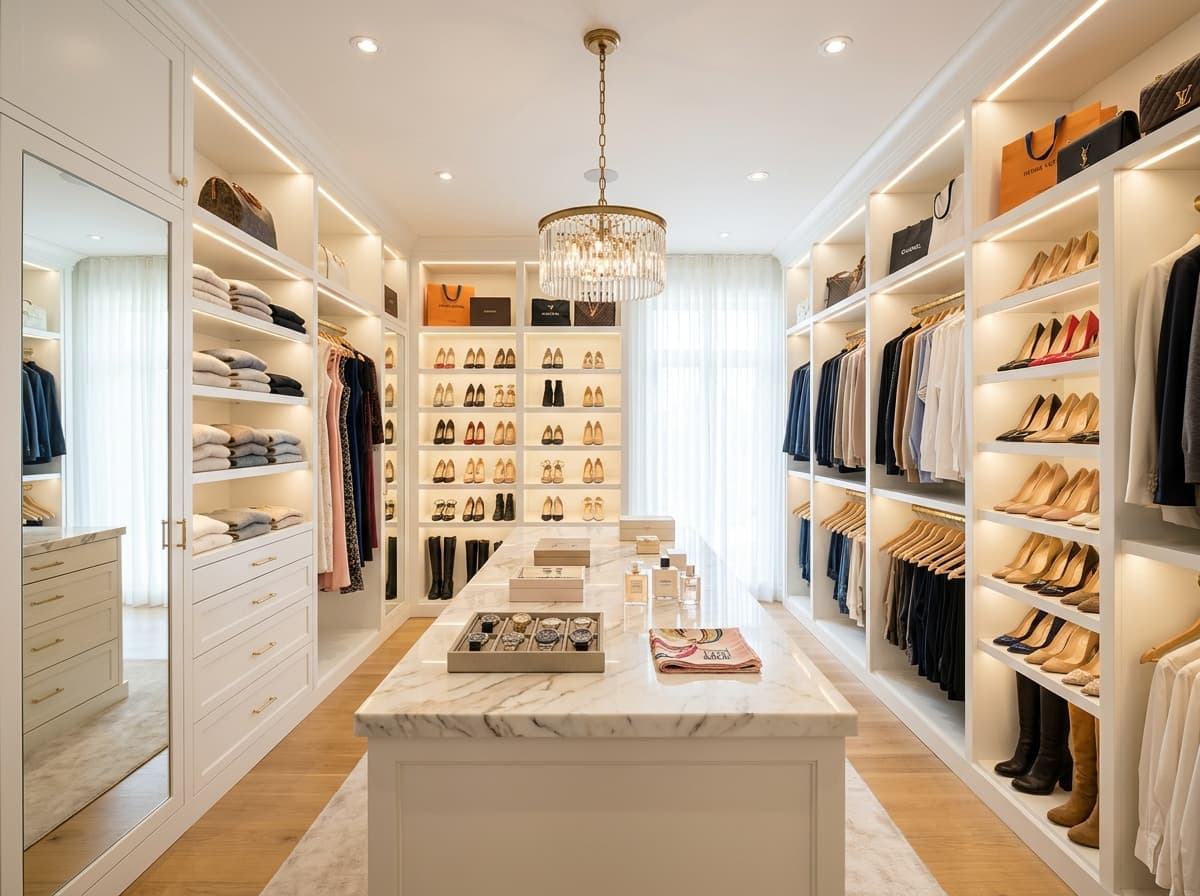
Rooms over 15 square meters: U-shaped with center island. The island adds a surface for drawer storage, a padded top for laying out clothing, and a visual anchor for the room. Islands start at AED 8,000 for a basic unit and reach AED 25,000 for a fitted island with glass-top display, internal LED lighting, and custom drawer configuration. The island-equipped dressing room is the format associated with Palm Jumeirah, Emirates Hills, and similar luxury community villas, where master bedroom suite sizes make a true dressing room viable.
**Why Dubai requires different material standards**
The most expensive walk-in closet mistake in Dubai is specifying standard furniture-grade MDF. Standard MDF absorbs moisture at panel joints, swells, and warps door fronts within two to three years in ground-floor villas, coastal apartments, and rooms with limited AC circulation. This is not a theoretical risk. It is the primary reason Dubai homeowners replace wardrobes well ahead of schedule.
The correct specification is moisture-resistant MDF throughout, identifiable by its green-tinted core in cross-section. This material is rated to the <a href="https://www.en-standard.eu/bs-en-622-5-fibreboards-specifications-part-5-requirements-for-dry-process-boards-mdf/" target="_blank" rel="noopener">EN 622-5 standard</a> and performs significantly better in humid indoor environments. Shelving bases and backing panels in high-humidity zones benefit from marine-grade plywood, which handles moisture exposure better than any MDF grade.
Hardware specification matters equally. Mild steel hanging rods, hinges, and drawer slides develop surface rust within 12 to 18 months inside a closed wardrobe with limited airflow. Stainless steel and zinc alloy components are the correct specification for Dubai. Blum and Hettich are the two hardware manufacturers with the longest documented performance record in UAE closet installations. Blum Clip Top hinges carry a 60,000 to 100,000 cycle rating. Generic soft-close hardware lacks this documentation and consistently underperforms in high-use Dubai applications.
**Finish options and their real-world implications**
Three finish categories cover the Dubai walk-in closet design market, each with a different durability and cost profile.
Melamine MDF: the most durable finish for Dubai conditions. The melamine layer creates a fully sealed surface that resists moisture, cleans easily, and maintains its appearance over 10 to 15 years with minimal maintenance. Available in a wide range of colours and textures including woodgrain embossing. Cost: AED 800 to 1,200 per linear meter installed.
Lacquer finish: a painted surface applied in multiple coats and cured under UV. Provides a seamless, furniture-quality appearance with no visible surface texture. Slightly less moisture-resistant than melamine at panel edges, which makes edge banding quality critical. Cost: AED 1,500 to 2,500 per linear meter installed. The most popular premium finish in Dubai villa closets.
Natural wood veneer: a thin slice of real timber bonded to MDF. The highest-specification finish used in luxury properties where the wardrobe design needs to match fine joinery elsewhere in the home. Requires the highest moisture-resistance specification underneath, with fully sealed edge banding on every panel. Cost: AED 2,000 to 3,500 per linear meter installed. According to <a href="https://www.dm.gov.ae/business/" target="_blank" rel="noopener">Dubai Municipality guidelines</a>, residential interior fit-out must use materials rated for the installation environment, which supports the case for veneer-over-MDF rather than solid timber in high-humidity zones.
**Interior configuration: where the design actually works**
The layout defines the room. The interior configuration determines whether the closet functions well. Five configuration decisions make the greatest practical difference.
Hanging zone height allocation: a walk-in closet for a couple typically needs at minimum 2 linear meters of long-hang space (minimum 1,400mm rail height, for dresses and formal coats) and 3 to 4 linear meters of short-hang space (900mm height, for shirts, jackets, and folded items on the shelf above). Under-specifying long-hang is the most common error in Dubai closet designs, leaving dresses folded over rods within the first month of use.
Double-hanging: in sections reserved for short garments, double-hanging rails increase hanging capacity by 60 to 80 percent. Two rails at 2,000mm and 1,000mm height allow two rows of short-hang items. This should be the default specification in any section that does not serve long-hang items.
Drawer depth and count: drawers are the most used storage element in a walk-in closet. Specify a minimum of 6 to 8 drawers of varying depths: shallow drawers (100mm) for accessories, jewellery, and folded items; medium drawers (150mm) for knitwear and jeans; deep drawers (200mm) for sweaters and bulky items.
Shoe storage: angled shelves at 200mm height per pair, 300mm depth. Floor-to-ceiling shoe shelving on a dedicated wall section is the most visually striking element of a <a href="/walk-in-closet-design-ideas">walk-in closet design</a> and the most requested feature in Dubai villa closets. 50 pairs of shoes require approximately 1.8 linear meters of wall width, ceiling to 2,400mm.
Lighting: warm white LED strips at 2,700 kelvin mounted along the top of each storage section. Door-activated switching or motion sensors eliminate the need to locate a light switch when entering. Dimmable control allows ambient light in the evening. LED lighting adds AED 2,000 to 5,000 to a standard installation and transforms the usability of a closet with limited natural light.
**What walk-in closet design costs in Dubai in 2026**
Cost is a function of room size, material specification, finish, hardware brand, and interior configuration complexity.
Entry-level design and fit-out (6 to 8 sqm, single-wall or L-shaped, melamine MDF, standard LED, Blum hardware): AED 15,000 to AED 25,000 complete.
Mid-range design and fit-out (8 to 12 sqm, U-shaped, lacquer or premium melamine finish, integrated LED, Blum soft-close throughout, shoe wall): AED 30,000 to AED 55,000.
Luxury dressing room (12 to 20+ sqm, U-shaped with center island, veneer finish, full LED system, glass display cabinets, motorized elements): AED 60,000 to AED 150,000+.
These figures include on-site measurement, 3D design, all material costs, hardware, delivery, and professional installation. A useful shortcut for budgeting: count the total linear meters of wall you intend to fill with storage, multiply by AED 1,000 for standard melamine or AED 2,000 for lacquer, and add AED 10,000 to AED 15,000 for island, LED upgrades, and design costs. This gives a working estimate within 20 percent of the final figure for most standard projects.
**Common design mistakes to avoid**
Three design decisions account for the majority of walk-in closet failures in Dubai homes.
Specifying standard MDF to save 10 to 15 percent on material costs. The short-term saving produces a wardrobe that swells, warps, and fails within three years in Dubai's humidity. Moisture-resistant MDF is not a premium upgrade. It is the baseline specification for any built-in wardrobe in the UAE climate.
Skipping the 3D design phase. A 2D floor plan does not show you what the closet actually looks like from inside. A 3D rendering lets you verify the ceiling height clearance, the proportion of hanging to drawer to shelf storage, the way light enters the space, and whether the finish reads as you intended. Approving a walk-in closet design without a 3D rendering is accepting a significant financial commitment without the information you need to evaluate it.
Under-specifying hanging capacity. Most couples need 6 to 8 linear meters of combined hanging in a shared walk-in closet. Designing to 4 linear meters to save cost leaves you with a wardrobe that is full on day one and unusable within a year as the wardrobe grows. Design to your actual wardrobe volume, not the volume that fits the budget more comfortably.
**Frequently asked questions about walk-in closet design in Dubai**
How much does walk-in closet design cost in Dubai? Design and fit-out starts from AED 15,000 for a compact 6 to 8 square meter room with moisture-resistant MDF. Mid-range projects for rooms of 10 to 12 square meters run AED 30,000 to 55,000. Luxury dressing rooms with center islands and veneer finishes range from AED 60,000 upward. Costs include 3D design, all materials, hardware, and professional installation.
What is the best walk-in closet design for a Dubai villa? U-shaped layouts suit the majority of Dubai villa closet rooms above 10 square meters. They maximize storage on three walls while maintaining a clear central aisle. For rooms above 15 square meters, adding a center island upgrades the room from a walk-in closet to a functional dressing room.
How long does walk-in closet design and installation take? From first consultation to installation handover is typically three to five weeks. Week one: on-site measurement and 3D design. Week two: design finalization and material selection. Weeks three to five: manufacturing and installation. Projects with specialty materials or imported finishes extend to six to eight weeks.
What materials should I specify for a walk-in closet design in Dubai? Moisture-resistant MDF for all structural panels. Melamine or lacquer finish on door fronts and exposed surfaces. Stainless steel or zinc alloy hardware from Blum or Hettich. Marine-grade plywood backing in high-humidity zones such as ground-floor rooms or rooms near the exterior of the building.
Walk-In Closet Dubai provides design consultations, 3D renderings, and bespoke <a href="/walk-in-closet">walk-in closet</a> fit-out across Dubai. Projects start from AED 6,000. Book a free on-site measurement and receive a complete 3D design before any manufacturing commitment. Contact us via <a href="/contact">our contact page</a> or call 052 600 1068.
Do walk-in closet designers in Dubai provide 3D renderings before manufacturing begins? A reputable company provides a 3D digital rendering after the on-site measurement visit and before any manufacturing commitment. The rendering shows the exact configuration, door type, lighting positions, and finish as it will appear in your specific room. This is the stage where layout adjustments, finish changes, and internal configuration changes are made at zero cost. Approving a walk-in closet without a 3D rendering means accepting a significant investment without seeing what you are receiving. If a company presents only a floor plan or showroom samples without a room-specific 3D, request the rendering as a condition of proceeding.
Need help designing your perfect wardrobe or closet? Talk to us.