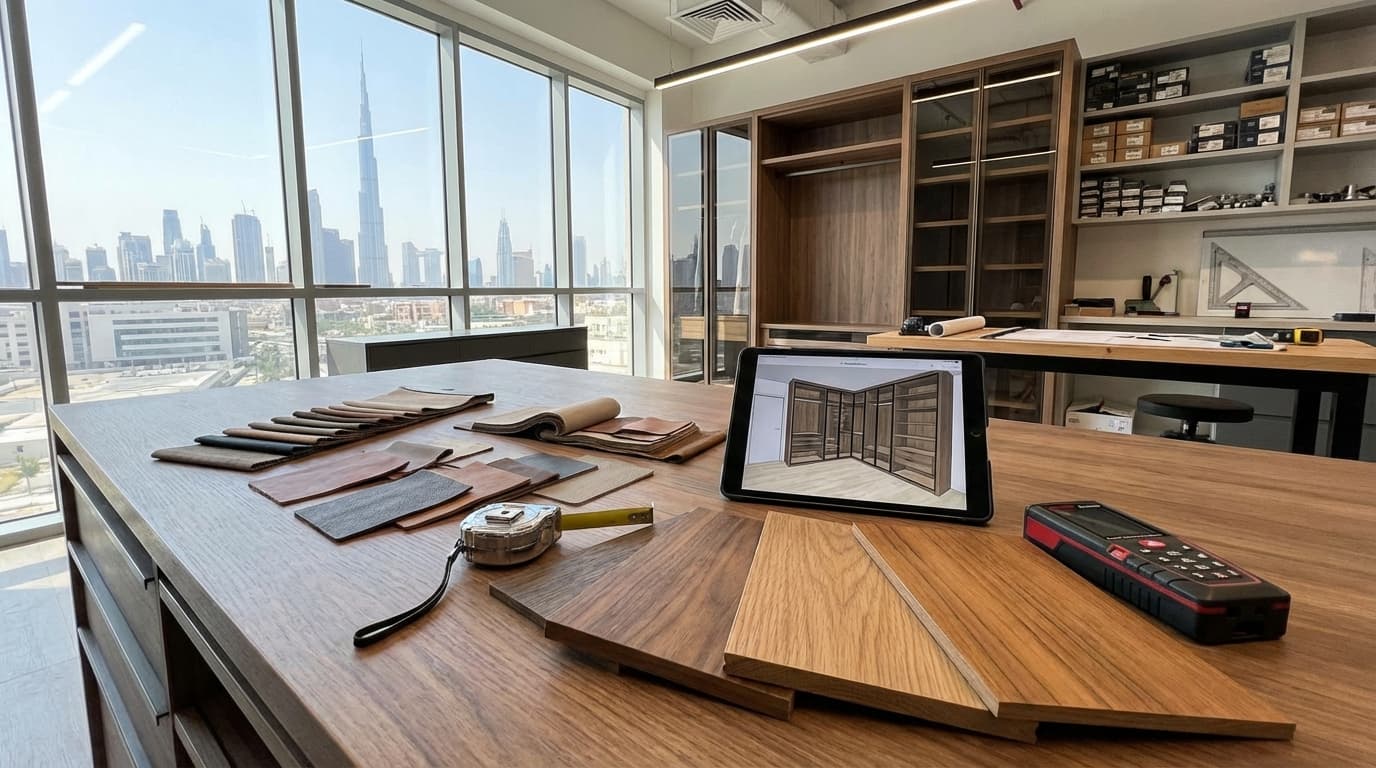
Wardrobe Materials Guide for Dubai
MDF, lacquer, veneer, or solid wood? Compare pricing, durability, humidity performance, and aesthetics for each wardrobe material option.
Choosing the right material for your wardrobe in Dubai requires understanding how each option performs in the local climate, how it looks, how long it lasts, and what it costs. This guide compares the four main material categories with specific pricing and performance data for UAE conditions.
MDF (Medium Density Fiberboard): The workhorse of Dubai wardrobes. Available in standard and moisture-resistant grades. The moisture-resistant version (green core) costs 10-15% more and is essential for Dubai installations — standard MDF can begin swelling within 12-18 months in ground-floor villas or high-humidity apartments near the coast. Finishes include melamine (pre-laminated, hundreds of colors and textures), vinyl wrap (seamless edges, smooth surface), and spray paint (custom color matching). Price: AED 800-1,200/lm for melamine, AED 1,000-1,500/lm for vinyl wrap. Lifespan: 10-15 years. Best for: budget to mid-range projects, rental properties, kids rooms, utility rooms.
Lacquer: Multi-layer spray finish applied to MDF substrate. Creates the smoothest, most seamless surface available. Options include high-gloss (dramatic, reflective, shows fingerprints), matte (sophisticated, hides marks, most popular in 2026 Dubai interiors), and satin (balanced sheen). Can be mixed to any RAL or Farrow & Ball color. Price: AED 1,500-2,500/lm. Manufacturing adds 5-7 days vs. melamine. Lifespan: 12-15 years with UV-resistant topcoat. Best for: master bedrooms, living areas, modern interiors, custom color requirements.
Veneer: Real wood surface (0.5-1mm) bonded to MDF or plywood substrate. Provides genuine wood grain, natural warmth, and unique character that laminates cannot replicate. Popular species in Dubai: walnut (warm brown tones, luxury feel), oak (lighter, Scandinavian aesthetic), eucalyptus (dramatic grain, becoming popular in Emirates Hills villas). Requires grain matching across panels for a premium look — ask your manufacturer to show you the grain before production. Sealed with lacquer for humidity protection. Price: AED 2,000-3,500/lm. Lifespan: 15-20 years. Best for: luxury bedrooms, dressing rooms, villa master suites in Dubai Hills, Arabian Ranches, and Palm Jumeirah.
Solid Wood: Rarely recommended for full wardrobe construction in Dubai due to humidity-related expansion, contraction, and cracking. Appropriate for accent elements (drawer fronts, handles, edge profiles) where small dimensions minimize movement. Teak performs best in humid climates due to its natural oil content, but even teak will move visibly over time in a wardrobe carcass. Price: AED 3,000-5,000+/lm for full construction (not recommended). Best for: accent elements only in Dubai, unless the room has consistent, year-round climate control with humidity held between 45-55%.
How to choose between materials by Dubai location: Palm Jumeirah and JBR (coastal, elevated humidity) require moisture-resistant MDF as an absolute minimum for all carcass and door components, with marine-grade plywood on horizontal surfaces. Emirates Hills and Arabian Ranches (inland villas, moderate humidity) can use standard moisture-resistant MDF throughout. Downtown Dubai and Business Bay apartments (well-sealed towers with central AC) are the most forgiving environment and can use any material grade. For investment properties and short-term rentals, melamine MDF at AED 800-1,200/lm is the practical choice. For primary residences you plan to occupy long-term, the premium finish pays for itself in aesthetics and longevity.
How material choice affects renovation projects. If you are planning a wardrobe renovation rather than a new installation, material choice has an outsized impact on total cost. Stripping out solid wood carcasses is labour-intensive. MDF and laminate carcasses disassemble faster and reduce disposal costs. Replacing door fronts on a lacquer wardrobe (repainting or re-skinning) is cheaper than replacing full veneer panels. Our renovation guide covers material swap costs and what is worth keeping versus replacing in a full redo. For pricing across all wardrobe types, see our custom closet cost breakdown for Dubai 2026.
Material specifications for built-in wardrobes. Built-in wardrobes fixed directly to walls and ceilings have slightly different requirements than freestanding designs. Thermal movement at fixing points matters more in tall units. Moisture-resistant MDF handles Dubai's humidity range reliably. For installations reaching 2,700mm ceilings, horizontal mid-rails break the carcass into two sections, reducing bow risk over time. See our guide on built-in wardrobes in Dubai for wall-fixed installation specifications.
How material choice affects sliding wardrobes. Sliding door panels in Dubai need specific material consideration: panels over 2,000mm height require 18mm MDF minimum to prevent bowing across the span. Lacquer and acrylic finishes hold up better than melamine on sliding panels because they resist scratching from frame contact over time. Aluminium-framed panels handle Dubai's temperature swings (from air-conditioned interiors to summer ambient heat) better than full-panel frameless systems. For sliding wardrobe material specifications by panel height and location, our sliding wardrobe guide for Dubai covers the full breakdown. For an independent comparison of wardrobe substrate materials, Blum's hardware guide explains how substrate quality affects long-term hardware performance.
Material choice and hardware compatibility. The material you choose for your wardrobe carcass and doors directly affects which hardware performs reliably long-term. Heavy veneer panels — particularly panels over 600mm wide — need Blum Clip Top hinges rated for 50,000+ cycles, not generic soft-close hinges that cannot handle the weight. Lacquer door fronts benefit from Hettich or Blum drawer runners because their sealed surface resists the micro-abrasion that wears through cheaper hardware finishes over time. Marine-grade plywood shelves in high-load zones (shoe shelves, drawer bases in wardrobe islands) pair best with pull-out hardware rated for 30kg per drawer — the structural rigidity of plywood prevents the shelf flex that causes cheaper pull-out runners to bind and fail. For a full comparison of hardware grades and which material they pair with in Dubai installations, see our company guide.
New for 2026: acrylic high-gloss wardrobe fronts. An increasingly popular finish in Dubai Hill Estate and Downtown high-rise bedrooms is UV acrylic: a thick acrylic sheet bonded directly to the MDF door panel, giving a mirror-like high-gloss surface that outperforms spray lacquer in scratch and fingerprint resistance. Acrylic panels are manufactured to order in China and imported — lead time is 6-8 weeks versus 3-4 weeks for local lacquer. Price is AED 1,800-2,800/lm, sitting between standard lacquer and veneer. The practical advantage in Dubai's sun-exposed bedrooms: UV acrylic is inherently UV-stable, so it does not yellow or fade on windows facing east or west as some lacquer formulations do over time. For communities like Dubai Marina and JBR where morning sun hits bedroom windows directly, acrylic high-gloss is worth considering for wardrobes on the sun-facing wall. For recently built villas in Dubai Hills Estate and Arabian Ranches, see our community-specific design guides: Dubai Hills walk-in closet and Mirdif villa wardrobe guide.
MDF, lacquer, and veneer summarized. MDF (moisture-resistant) is the carcass foundation for every wardrobe in Dubai regardless of finish tier. It is structural, not decorative. Lacquer and veneer are competing finish options applied on top of the MDF substrate. Melamine MDF at AED 800-1,200/lm means the MDF comes with the finish already factory-bonded. Lacquer at AED 1,500-2,500/lm means the MDF carcass gets a bespoke spray finish in any colour after manufacturing. Veneer at AED 2,000-3,500/lm means a real wood slice is bonded over the MDF surface and sealed with lacquer topcoat for humidity protection. All three options use the same moisture-resistant MDF carcass. The choice between them is entirely about aesthetics, budget, and desired lifespan of the visible surface. For installation questions once you have chosen your material, our wardrobe fitters Dubai guide covers what the fitting process involves from first measurement to handover.
Ready to choose? Book a free design consultation and we will recommend the right material for your space, lifestyle, and budget.
What We Provide
Related Guides
Frequently Asked Questions
Moisture-resistant MDF with melamine finish offers the best balance of price, durability, and humidity performance. For premium aesthetics, matte lacquer on MDF is the most popular choice. For natural wood lovers, veneer on MDF or plywood provides the look without the instability of solid wood.
Get a Free Design Consultation
Share your room dimensions and we will create a 3D design with a transparent quote. No obligation.