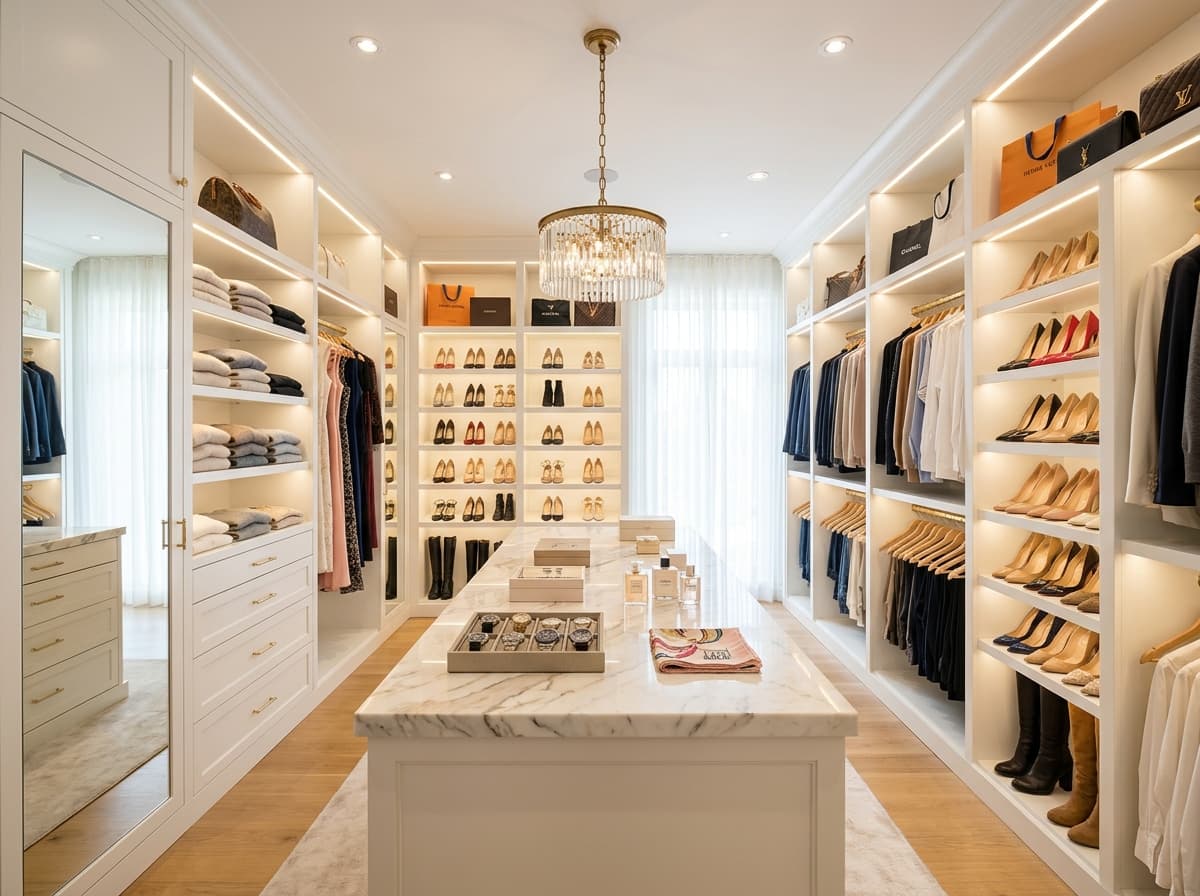
Walk-In Closet Guide: Everything You Need to Know Before Building in Dubai
A walk-in closet is the most-requested home upgrade across Dubai's villa market. Getting one right means understanding three things before you call a single company: what layout your room can support, which materials actually hold up in UAE humidity, and what a realistic budget looks like. This guide covers all three in detail.
What Makes a Walk-In Closet Work in Dubai
The minimum room size for a functional walk-in closet is 5 square meters with at least 1.4 meters of clear floor width for the aisle. Below that, a fitted wardrobe installed floor-to-ceiling against a bedroom wall is more practical — it stores more per square meter and does not waste the room's center on a narrow corridor.
For rooms between 5 and 8 square meters, an L-shaped layout is the most efficient configuration: one wall handles all hanging, the perpendicular wall handles shelving and drawers, and the center stays clear for dressing. For rooms above 10 square meters, a U-shaped layout using three walls significantly increases storage capacity. Rooms above 15 square meters can accommodate a center island — a freestanding unit with drawers and a work surface that becomes the design centerpiece of the room.
Dubai's villa communities show consistent room patterns: Palm Jumeirah and Emirates Hills villas typically have dedicated closet rooms of 15 to 30 square meters. Arabian Ranches and Dubai Hills Estate villas average 10 to 18 square meters. JVC and Dubai Marina apartments offer 5 to 9 square meters — compact but workable with the right layout approach.
Walk-In Closet Materials: What Actually Lasts in UAE Conditions
Material selection is where most Dubai walk-in closet projects succeed or fail long-term. UAE humidity averages 65 to 85 percent outdoors in summer, while air-conditioned interiors run at 40 to 55 percent. This cycle of humidity stress is the reason standard furniture-grade MDF wardrobes fail within two to four years — the joints swell, door fronts warp, and drawer runners bind.
Moisture-resistant MDF is the correct carcass material for any built-in wardrobe in Dubai. It costs 10 to 15 percent more than standard MDF and is identifiable by its green or blue cross-section at cut edges. Any company quoting standard MDF is cutting a corner that will cost you more in repairs or replacement within a few years.
Finish tiers in ascending order of cost and durability:
Melamine-faced MDF (AED 800 to 1,200 per linear meter) is a factory-applied laminate over the moisture-resistant core. It is the most affordable option and comes in hundreds of colors and wood-effect prints. It is durable, easy to clean, and the right specification for rooms with good ventilation and moderate humidity.
PVC wrap (AED 1,000 to 1,500 per linear meter) is a thermally bonded film that wraps the MDF including edges. It outperforms melamine on edge-knock resistance and is popular in family homes in Arabian Ranches, Springs, and Mirdif.
Lacquer finish (AED 1,500 to 2,500 per linear meter) is sprayed lacquer on moisture-resistant MDF, creating a continuous sealed surface. It is the easiest finish to clean and resists moisture penetration at the micro level. Matte greige, warm white, and soft grey are the dominant requests in Dubai in 2026.
Natural veneer (AED 2,000 to 3,500 per linear meter) bonds a thin slice of real wood (walnut, oak, ash) to a moisture-resistant MDF substrate. It looks and feels like solid wood while performing like engineered timber. Veneer surfaces in coastal locations (Palm Jumeirah, JBR) should be sealed with lacquer topcoat.
Hardware matters as much as the carcass. Blum and Hettich are the two hardware brands with a documented performance record in UAE closet installations. Soft-close hinges from Blum are rated for 60,000 to 100,000 opening cycles. Generic hardware from unknown brands typically shows rust and binding within 18 months in Dubai conditions.
Walk-In Closet Cost in Dubai: 2026 Pricing Table
The most reliable way to budget is per linear meter of storage installed:
Small walk-in closet (6 to 8 sqm, L-shaped, 8 to 10 linear meters): MDF melamine AED 12,000 to 18,000 / Lacquer AED 20,000 to 30,000 / Veneer AED 25,000 to 40,000.
Medium walk-in closet (10 to 14 sqm, U-shaped, 15 to 20 linear meters): MDF melamine AED 18,000 to 30,000 / Lacquer AED 30,000 to 50,000 / Veneer AED 40,000 to 70,000.
Large walk-in closet or dressing room (15 to 25 sqm with center island, 20 to 30 linear meters): MDF melamine AED 28,000 to 45,000 / Lacquer AED 50,000 to 85,000 / Veneer AED 65,000 to 120,000.
Luxury Emirates Hills or Palm Jumeirah dressing room (20 to 35 sqm, island, display cases, full LED lighting): AED 80,000 to AED 200,000 depending on specification.
A center island adds AED 8,000 to AED 25,000 depending on size and material. Integrated LED lighting adds AED 3,000 to AED 8,000. A vanity station with mirror surround lighting adds AED 2,000 to AED 5,000. For a full breakdown by project type, see our cost guide.
The Design Process: From Consultation to Handover
A quality walk-in closet project follows a five-step sequence. Week one: on-site measurement and 3D design production. You receive a digital rendering of the completed closet — this is the moment to adjust the layout, finish, and hardware before any manufacturing commits. Week two: design finalization and material sample selection. Weeks three to five: manufacturing (10 to 15 working days) and installation (one to two days for a standard room, two to three days for a room with a center island). A follow-up visit within the first week after installation handles door alignment and punch-list items.
The 3D rendering before manufacturing is non-negotiable. Any company that skips this step is asking you to approve a purchase without seeing what you are getting. Walk away.
Common Walk-In Closet Mistakes in Dubai (and How to Avoid Them)
Underspecifying hanging space is the most frequent error. Most couples need 4 to 6 linear meters of hanging divided between long-hang sections (1,400mm minimum clearance for dresses and coats) and short-hang sections (900mm clearance for shirts, jackets, and folded trousers). Designers who default to a single-rail layout leave half the room's hanging potential unused.
Ignoring humidity protection at the specification stage creates problems that compound over time. Cedar blocks and silica gel sachets help with maintenance, but they do not compensate for a carcass in standard MDF. Get the material specification right at the start.
Adding a center island to a room under 10 square meters reduces the aisle below 900mm, making daily use awkward. In compact rooms, a pull-out island (600mm wide, retracts under shelving when not in use) delivers drawer storage without the permanent footprint.
Choosing pre-made modular systems to save money often costs more in the long run. A modular system from IKEA or similar retailers starts at AED 5,000 to 8,000, but standard-grade materials in UAE conditions fail earlier, and the unit leaves gaps at walls, ceilings, and corners that a built-in system fills precisely. Over a five-year ownership period, the cost difference versus a basic custom fit-out narrows significantly. For a direct cost and durability comparison, see our IKEA comparison.
Questions to Ask Before Signing Any Contract
What material grade do you use? The answer should specify moisture-resistant MDF by name, not "quality MDF."
Which hardware brand do you use? Blum and Hettich are the quality benchmarks. Generic hardware is a cost-cut that shows within two years.
Do you provide a 3D rendering before manufacturing? If not, do not proceed.
What warranty do you offer? Five years structural and two years hardware is the industry standard for quality work.
Can you provide references from UAE projects completed in the last 12 months? Ask specifically for projects in your community or a similar humidity environment.
The Dubai Municipality requires interior joinery contractors to hold a valid Dubai trade licence. Verify this before signing any agreement.
Next Steps
For layout plans by room size and community, see our design ideas. For design direction and aesthetic choices for 2026, see our design guide. For a full commissioning walkthrough, see our wardrobe guide.
Walk-In Closet Dubai designs and builds custom walk-in closets across Dubai from AED 12,000. Every project starts with a free on-site measurement visit and a full 3D design render before any manufacturing begins. WhatsApp us on 052 600 1068 to book your free consultation.
Need help designing your perfect wardrobe or closet? Talk to us.