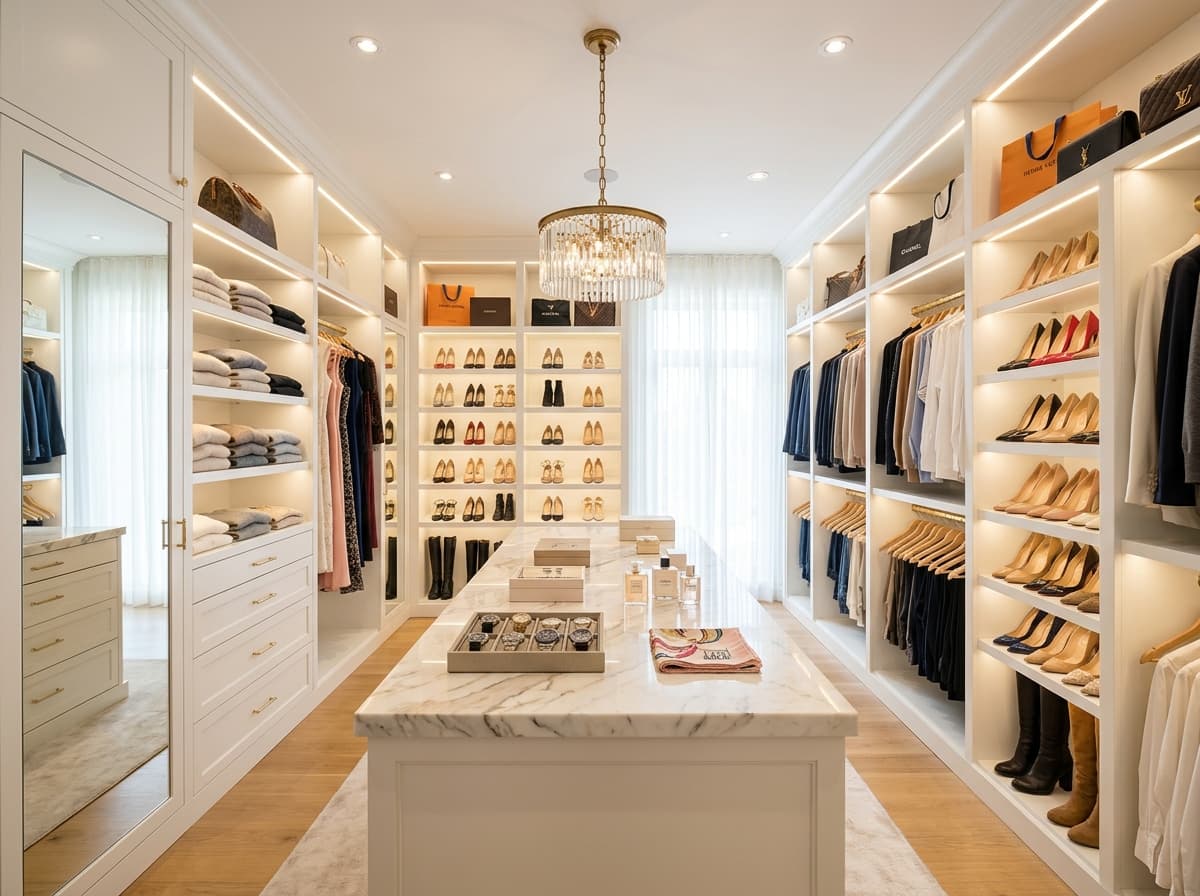
Custom Made Wardrobe Dubai | Costs, Materials & What to Expect
The custom made wardrobe Dubai residents order from specialist fitout companies is a built-in joinery unit manufactured to the precise dimensions of your room, using materials specified to perform in the UAE's humidity conditions. The result fills the space from wall to wall and floor to ceiling, with no gaps, no exposed base legs, and no standard-width modules forced into non-standard rooms.
This guide explains what custom made means in practice, what it costs in 2026, which materials to specify, and how to compare quotes from Dubai wardrobe companies accurately.
What Does Custom Made Wardrobe Mean in Dubai?
The term "custom made" covers a range of products in Dubai's wardrobe market. At one end, IKEA's PAX system is marketed as customizable: you choose from fixed frame widths (50, 75, or 100 cm), select door fronts and internal fittings, and the result is assembled in your room. At the other end, a fully bespoke custom made wardrobe starts with a site measurement, produces a 3D design to your exact room dimensions, and manufactures every panel to millimetre tolerance before installation.
The practical difference matters in Dubai. Most Dubai villa bedrooms and apartment rooms have walls that do not align with PAX's 50 or 75 cm module widths. A wall that measures 3.4m cannot be filled with PAX frames without either leaving a gap or adding a filler panel that visually interrupts the run. A genuinely custom made wardrobe fills 3.4m exactly, with no gap and no filler. This is the core functional advantage of custom manufacturing over module-based retail systems.
According to the Dubai Municipality business directory, fitted wardrobe installation is classified as interior joinery work, requiring a licensed carpentry contractor. Both bespoke and module-based custom wardrobes fall under this classification for installation purposes.
Custom Made Wardrobe Dubai Cost: 2026 Price Guide by Finish
Custom made wardrobe pricing in Dubai in 2026 runs from AED 6,000 for a compact single-wall bedroom unit to AED 120,000 and above for a full luxury dressing room with veneer finish and center island. The main cost variables are finish type, room size, internal fittings, and hardware specification.
Cost by finish tier per linear metre of joinery: melamine laminate runs AED 1,800 to AED 2,800 per linear metre, including carcass, doors, and standard internal fitting. Lacquer spray finish runs AED 3,200 to AED 5,000 per linear metre. Veneer finish runs AED 2,800 to AED 4,200 per linear metre. These are installed costs including design, manufacturing, delivery, and Blum or Hettich hardware. Labour-only rates from unlicensed carpenters are lower but carry no warranty and use unspecified materials.
A realistic 2026 budget guide for common project types: a 3-metre bedroom wall custom made wardrobe in melamine with soft-close hinges and two drawer banks costs AED 10,000 to AED 16,000. A walk-in closet in a 8 sqm room with U-shaped layout in melamine costs AED 22,000 to AED 35,000. The same room in lacquer costs AED 35,000 to AED 55,000. A full dressing room with lacquer, center island, and shoe wall in a 14 sqm room runs AED 60,000 to AED 100,000+. For a complete cost breakdown by room size and finish tier, see our walk-in closet cost guide.
Is It Cheaper to Build or Buy a Wardrobe in Dubai?
For rooms with standard wall dimensions, retail wardrobes can be cheaper in upfront cost. A configured IKEA PAX system for a 3-metre wall with premium Axstad doors and full internal accessories costs AED 9,000 to AED 14,000 with professional assembly. A custom made wardrobe for the same wall in melamine costs AED 10,000 to AED 16,000. The price difference is modest.
The cost comparison shifts over a longer timeline. Custom wardrobes use moisture-resistant MDF (MR MDF) rated to EN 622-5 MDF.H specification, which resists swelling and joint failure in Dubai's June-to-September humidity cycle (65-85% relative humidity). Standard particleboard, used in most retail flat-pack wardrobes, absorbs moisture and develops joint failure within 3-5 years in rooms with inconsistent AC use. Custom wardrobes backed by a 5-year structural warranty typically outlast two replacement cycles of retail alternatives in humid Dubai conditions.
For rooms with non-standard dimensions, custom made is almost always more cost-effective. A 3.4m wall requires either a custom-made unit or a PAX system with filler panels and visible gaps. The custom unit fits precisely, uses every centimetre of the wall, and looks finished. The retail workaround looks compromised regardless of how much it costs.
Custom Made Wardrobe Dubai: Materials That Last in UAE Humidity
Three material choices are most common in Dubai's custom wardrobe market. Moisture-resistant MDF is the carcass standard for all quality fitout. The carcass is the internal structure, shelf boards, and side panels. MR MDF does not absorb humidity. Standard MDF and particleboard do. A custom wardrobe quoted without explicit MR MDF specification is not suitable for Dubai residential installation, particularly in apartments with window units or inconsistent central AC.
For door and visible surface finish, the three options are melamine laminate, lacquer, and veneer. Melamine is a printed decorative paper bonded to MDF under heat and pressure. It is the most durable surface for everyday contact, available in dozens of colours and woodgrain prints, and the easiest to clean. Lacquer is a spray-applied paint finish on MDF, producing a smooth, seamless surface. It outperforms veneer in humid conditions because there is no natural wood grain to expand. Veneer is a real wood surface and requires UV-protection from direct sunlight to prevent fading over 3-5 years. For a detailed comparison of these materials and when each is worth the premium, see our wardrobe materials guide.
Hardware is the third material variable. Blum and Hettich are the benchmark brands in Dubai residential joinery. Blum hinges and drawer runners are rated for 60,000 to 100,000 opening cycles. Blum's UAE product catalogue covers the CLIP top hinge system and TANDEMBOX drawer system used in quality custom wardrobe installations. Hardware from unspecified sources typically degrades within 3-5 years and is not covered under any meaningful warranty.
What Is the 70/30 Rule for Wardrobe Organisation?
The 70/30 rule for wardrobes refers to internal fitting allocation: roughly 70% of a wardrobe's internal space should be dedicated to hanging (clothing on rails) and 30% to folded storage (shelving, drawers, shoe racks). The ratio reflects how most people actually store clothing. Shirts, jackets, dresses, and coats need hanging space. Folded items, shoes, and accessories need fixed storage. A wardrobe that inverts this ratio, with more shelving than hanging, creates a practical storage problem regardless of how well it is made.
In practice, the 70/30 starting point adjusts for individual households. A wardrobe for two people with substantial suit collections and formal wear may need 80% hanging. A wardrobe primarily for casual wear with large shoe collections may work better at 60/40. The design consultation stage of a custom made wardrobe project is the right moment to review the household's actual clothing inventory and specify the internal fitting layout accordingly. A well-run fitout company will ask about clothing types and volumes before producing a 3D design. One that jumps straight to standard configurations is working from a template, not from your requirements.
How Do You Compare Custom Wardrobe Quotes in Dubai?
When comparing custom made wardrobe quotes from Dubai suppliers, the quote must specify five variables for a meaningful comparison: carcass material (MR MDF or standard MDF, with thickness, typically 18mm), back panel type (full back or rebated back panel, 3mm or 6mm), finish type and application method (melamine laminate or spray lacquer, not "high gloss paint"), hardware brand (Blum, Hettich, or unspecified), and what is included in the price (design, manufacturing, delivery, installation, warranty duration).
A quote that is 25-30% lower than comparable quotes for the same room size and finish usually reflects a specific compromise: standard MDF instead of MR MDF, unbranded hardware, or a shorter warranty period. These are legitimate cost reduction choices if you understand the trade-off. They are a problem if the quote presents them as equivalent to a higher specification.
350+ completed wardrobe and closet projects across Dubai is the benchmark of a company with real installation experience across community types, property ages, and room configurations. Free on-site measurement and design consultation is the standard starting point. Contact us on WhatsApp 971526001068 to book your site survey.
Need help designing your perfect wardrobe or closet? Talk to us.