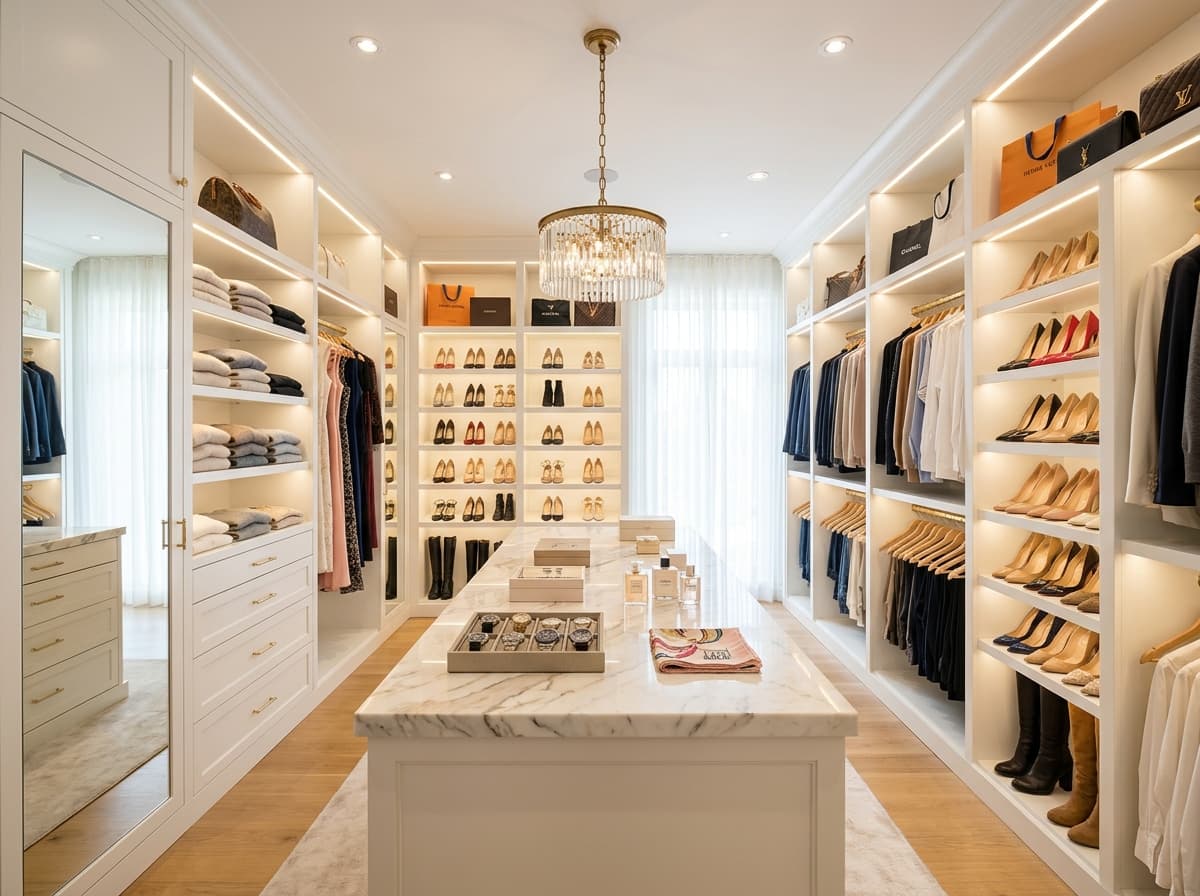
Design Your Walk-In Wardrobe: A Dubai Guide
Why a Well-Designed Walk-In Wardrobe Transforms Your Daily Life
A well-designed walk-in wardrobe transforms how you dress and live. Rather than reaching into a crowded closet, you'll move through an organized space where every piece is accessible, preserved, and used properly. How to design a walk-in wardrobe starts with one core principle: every linear meter should earn its place and serve your lifestyle. In Dubai's heat and humidity, the design question becomes both aesthetic and practical. You're protecting significant investments in quality clothes while creating a space that feels like your own private boutique. Most people initially think wardrobe design is purely about aesthetics: color palettes, material finishes, and lighting design. That's actually only half the story. The real work lies in planning how your clothes live: which items need full-height hanging rails, which should stack or fold, and what hardware withstands sagging in our climate without failure. We'll walk you through each decision that matters, from initial planning to the final installation reveal.
What Size Should a Walk-In Wardrobe Be?
The ideal size depends on your collection volume, your household composition, and available space. A compact walk-in for a couple or single person works effectively in 6-10 square meters (roughly 3m × 2m minimum). That's sufficient for full-height hanging on two walls, robust shelving for stacks, and a small island or bench for changing and planning outfits. Mid-range installations typically occupy 12-15 square meters, with dedicated zones: one wall for formal wear, another for everyday clothes, shelving for accessories and shoes, and room to move comfortably between sections. Luxury dressing rooms start at 20 square meters, adding islands for folding, seating areas, dedicated mirrors, and specialized storage zones. In Dubai apartment blocks like JBR Marina, 10 square meters is realistic and works beautifully with thoughtful design. Villas in Arabian Ranches and Dubai Hills often have space for 15-20 square meters, allowing separate sections for each household member or by clothing category. Start by measuring your current wardrobe volume. If it fills a standard bedroom closet, a 10-12 sqm walk-in is your realistic target. If you have overflow boxes under beds, plan for 15 sqm or more. The key question isn't 'how much space do I have available' but 'how much do I actually own today.' Start from that reality and plan accordingly.
What Features Should Your Walk-In Wardrobe Include?
A truly functional wardrobe combines hanging rails, shelving, drawers, and at least one flexible zone for seasonal or undecided items. Full-height hanging rails (2.4m) are standard for shirts, dresses, jackets, and coats. Plan approximately 1.2-1.5 linear meters of hanging per person. Double-rail systems work only if your space and reaching height allow; they're harder to navigate in compact rooms. Shelving works best for knits, jeans, and heavier pieces that crease when hung on hangers. Folded sweaters and items live longer and better on shelves than dangling from hooks. Drawers store underwear, socks, and accessories out of view, dust, and direct light. Soft-close hinges and drawer mechanisms are now standard practice; they're no longer luxury add-ons. Open shelving or glass-fronted cabinets suit collections you want to display. Closed MDF shelving is more practical and dust-resistant, critical in Dubai where sand infiltrates everything despite your best efforts. Add a full-length mirror (if space allows) and thoughtful task lighting. A dressing table or island with mirror means you can coordinate outfits inside the wardrobe itself. Consider pullout rails for seasonal rotation of winter coats and summer linens. In Dubai's steady 35°C+ heat, ventilation matters less than in cooler climates, but a ceiling fan keeps the space fresh. For detailed guidance, see our fitted wardrobe resource.
What Is the Most Efficient Walk-In Wardrobe Layout?
Efficiency comes from matching your daily routine and traffic patterns to the layout. The three standard layouts are gallery (narrow space, two walls of storage, walking through like a showroom), L-shaped (two adjoining walls, suited to corners), and island-based (central island with storage on all sides). Gallery layouts work in narrow spaces and let you visually scan everything at once. L-shaped is the most common in Dubai apartments; it maximizes corner space and uses one wall for the room entry door. Island-based layouts require more square meters but give you a dedicated dressing zone in the middle with storage surrounding all sides. In all three layouts, one rule applies universally: your most-used items should be at arm's height and eye level (roughly 1.2-1.7m high). Daily clothes hang or fold here. Seasonal pieces and formal wear go higher or lower. Accessories live near the mirror. Shoes sit on the floor or dedicated shelving on one wall. In Dubai homes, this layering adapts to humidity: delicate fabrics and leather go in the coolest corner (often interior walls, away from windows and direct sun). Moisture-resistant MDF and marine-grade plywood prevent swelling year-round. A professional 3D design render before manufacturing shows exactly how traffic flows and whether each household member has their own zone. That preview often catches inefficiencies (a mirror positioned wrong, a rail height wrong, insufficient folded storage) before fabrication begins.
How Do Dubai's Climate Challenges Affect Wardrobe Materials?
Dubai's humidity levels (50-90% depending on season and proximity to coast) demand materials that won't swell, warp, or harbor mold growth. Moisture-resistant MDF is the industry standard, suitable for custom wardrobes starting from AED 6,000 upward. It's solid, affordable, and proven in Dubai apartments for multiple decades. Lacquered finishes add aesthetic refinement and durability. Lacquer-finished wardrobes run AED 1,500-2,500 per linear meter and handle humidity better than raw MDF surfaces. Veneer (real wood veneer, usually walnut, oak, or teak) sits in the luxury tier at AED 2,000-3,500 per linear meter and gives the bespoke feel that defines Walk-In Closet Dubai's signature designs. Marine-grade plywood (mahogany or teak) is overkill for most interior wardrobes but suits coastal villas and beachfront properties in Palm Jumeirah, where salt air accelerates corrosion and wood degradation. Hardware (hinges, soft-close mechanisms, sliding rails) must be German-engineered (Blum is the industry standard) to withstand sustained heat and humidity without loosening or failing. Cheap hardware fails within 2-3 years in Dubai's demanding climate. A 5-year hardware warranty, standard in professional installations, gives you genuine peace of mind. LED lighting strips mounted on shelves and inside cabinets reduce shadow and heat output compared to older halogen systems, and they last 10+ years reliably. Learn more about material standards at design resources.
How Does the Professional Design Process Work From Start to Finish?
A professional design journey starts with your initial consultation call. Walk us through your space in detail: exact room dimensions, where doors and windows are positioned, your current wardrobe volume and categories, and your daily routine. Do you work from home and need visible, coordinated outfits? Are you storing formal wear for rare events? Do you travel frequently? These answers shape the optimal layout. Next comes the 3D render (a photorealistic digital model showing exact placement of every rail, shelf, drawer, and light). You see it before we cut a single piece of material. This is where mistakes surface and get fixed for free. Once you approve the render, manufacturing begins in our workshop (typically 10-15 working days). Installation happens on a single day (usually 4-6 hours for standard walk-ins), with minimal disruption to your home. We handle permits for apartment complexes. Communities like JBR, Marina, and Arabian Ranches have specific approval procedures, and we coordinate with your building management throughout. After installation, we show you how to load and organize the wardrobe effectively (yes, that matters significantly). A coat hanger in the wrong spot wastes space and strains the hardware unnecessarily. Total turnaround from consultation to moving clothes in ranges from 3-5 weeks. Pricing ranges from AED 20,000 for a compact walk-in (6-10 sqm, MDF) to AED 150,000+ for a luxury dressing room with island, veneer, and integrated seating. Pricing is transparent and listed per-linear-meter, so you know costs upfront.
Need help designing your perfect wardrobe or closet? Talk to us.