Villa Renovation Joinery in Dubai, Planned as One Job
Should joinery Dubai be planned from day one of a villa renovation?
Most villa renovations are planned trade by trade. The plasterer has a date, the electrician has a date, the tiler has a date, and somewhere near the end someone asks who is building the wardrobes. By then the walls have moved, the bedroom is the wrong shape for the rail, and the joiner is working around decisions nobody made with the joiner in the room. We treat joinery Dubai work as part of the renovation itself, not a finish added at the end.
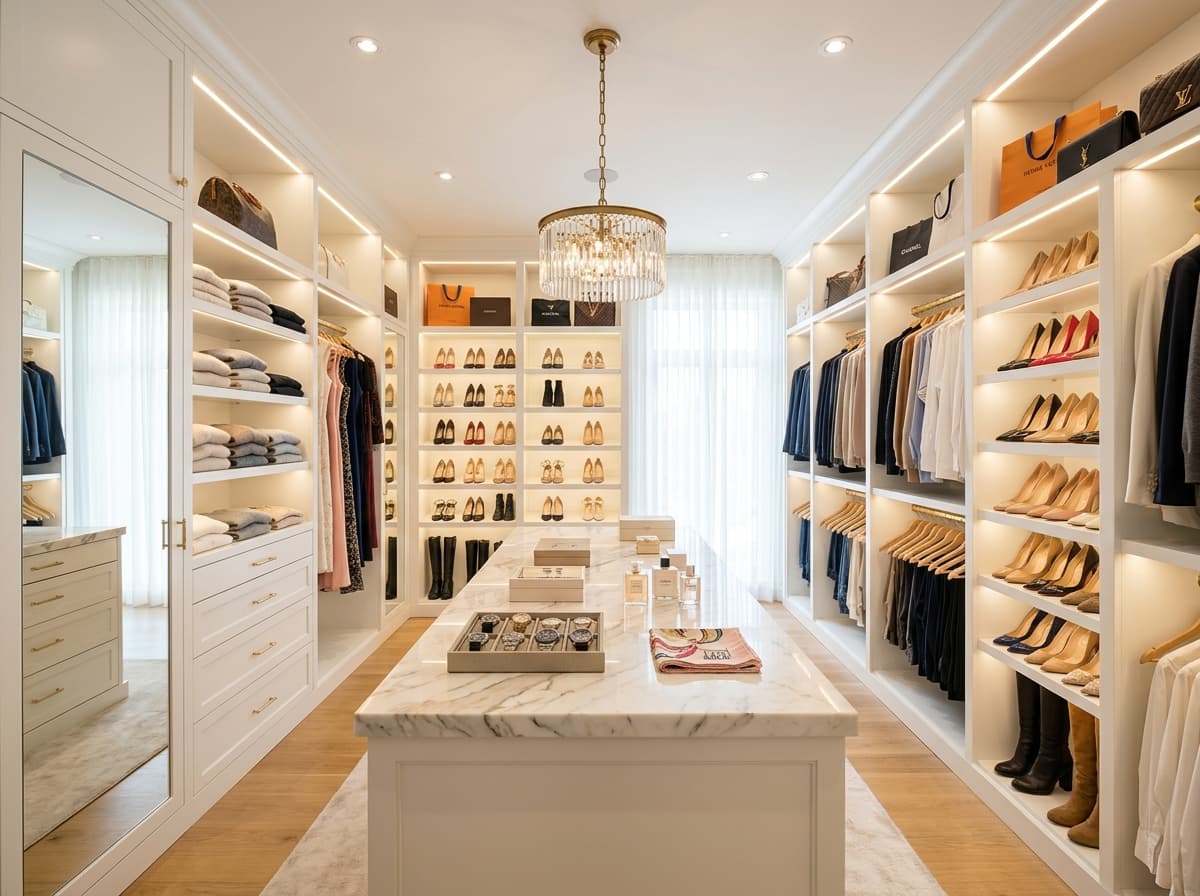
Walk-in closets, dressing rooms, bedroom wardrobes, vanities and internal doors go into the same scope as the structural work, because they depend on the same measurements. Where the new walls go is often decided by where the closet goes, so the closet belongs in the first conversation, not the last one.
The order of the trades decides where the joinery goes
A villa renovation runs in layers, and the joinery sits near the end of them. First fix comes first: cables, pipework, the AC lines and the ducts for a dressing room are run while the walls are still open. The lighting strip inside a wardrobe, the sockets for a dressing room mirror and the feed for an island drawer unit all have to be in the wall before the plaster goes on.
Plaster, screed and paint come next, and the joinery goes in once the room is finished. If the electrician has never seen the wardrobe drawings, the socket ends up behind the hanging rail. We send the joinery drawings to the contractor before first fix starts, so every cable is routed for the furniture that will stand in front of it.
Who takes the final measure, and when?
The survey measure is for the design. The final measure is for manufacture, and it is taken once the plaster is dry and the room is in its finished state. A room that was square at the survey can be out by a few millimeters after the plaster goes on, and a wardrobe built to the survey dimensions will show the gap at the end wall.
Our joiner visits the room a second time, checks the walls for plumb and the floor for level, and records the openings, the skirting depth and the position of every socket and switch. Only then is the panel cut. It is one extra visit, and it is the reason the doors close flush when the wardrobe is fitted.
Protecting the villa while other trades work
Joinery is built in our Dubai workshop, so the time on site is short. The risk sits in the gap between delivery and fitting, when panels are stacked in a room that is still damp from the screed. MDF takes up moisture from a wet slab, and a board left flat on a damp floor for a week can swell at the edges before it is fixed. Panels are stored flat, off the floor and under cover, and the room is dried before the first panel comes in.
The dressing room door stays shut while the painters work, and dust sheets go over every cut panel. Vanity tops are measured last, after the tiler has finished, because a thicker tile bed changes the height of the basin.
What does joinery Dubai cover, room by room?
A typical villa scope covers the principal suite's walk-in or dressing room, the wardrobes in the other bedrooms, a vanity unit with mirror for each bathroom that is being redone, a TV wall with concealed storage, and the internal doors with their frames. Laundry and store rooms get shelving and a hanging rail.
Each room is drawn in 3D before anything is manufactured, so the owner sees the layout, the lighting and the hardware before a single panel is cut. The dressing room is usually the largest part of the job, and it gains the most from careful layout work. The full brief is on our dressing room design page, and the wardrobe options for the other bedrooms are on the villa wardrobe page.
How long does joinery Dubai take, and what does it cost?
The workshop builds the joinery while the site is still being finished, so the wardrobes are not the last thing a renovation waits for. The on-site fitting is a short job compared with the structural work, but it can only start once the room is ready, so the date is set by the walls, not by the joiner. Published rates start at AED 20,000 for a compact walk-in closet and run from AED 35,000 to 55,000 for a mid-range lacquer one with Blum hardware. Lacquer built-ins are AED 1,500 to 2,500 per linear meter.
For how the scope is priced room by room, the walk-in closet renovation page sets out the ranges. Ask for a written quote that lists each room, the finish and the hardware, so the joinery can be compared line by line with any other supplier.
Related Guides
Need help designing your perfect wardrobe or closet? Talk to us.