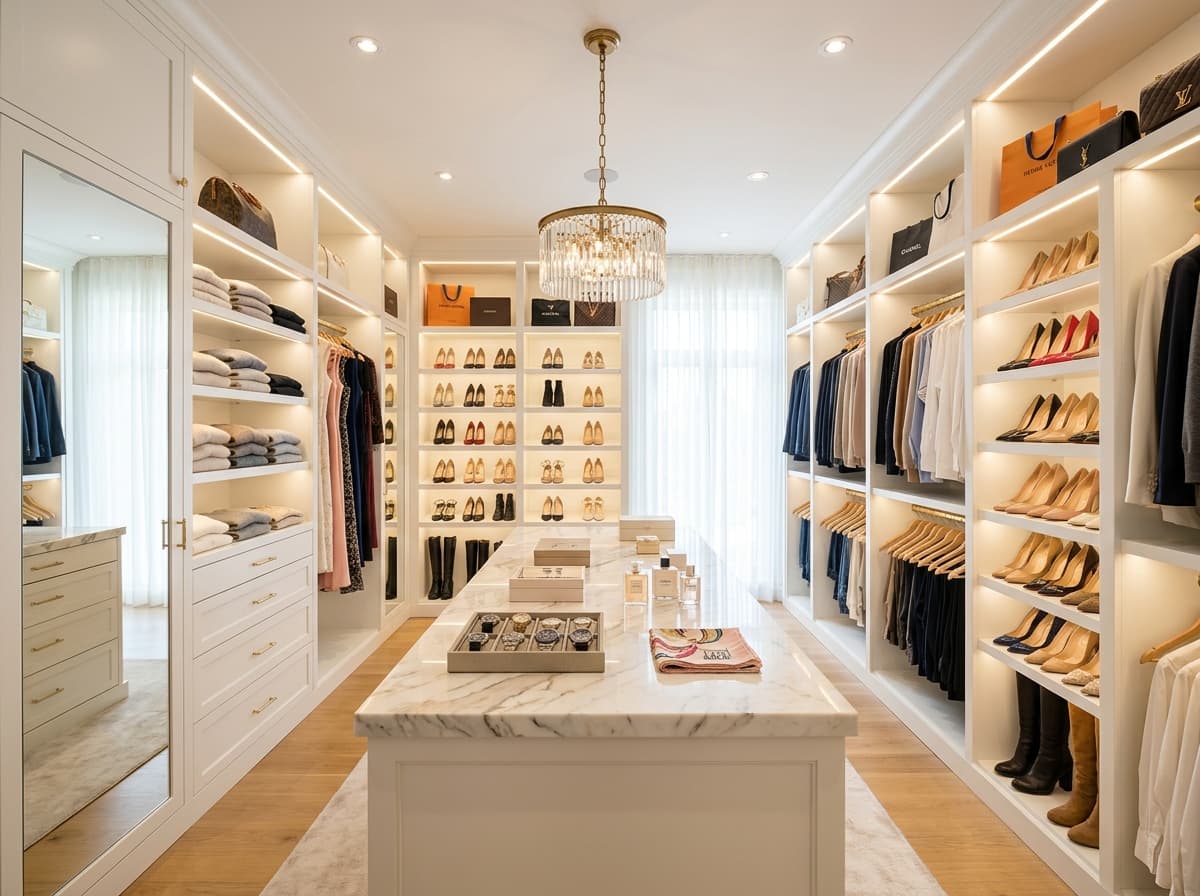
Wardrobe Humidity Dubai: How to Protect Your Closet from the UAE Climate
Wardrobe humidity is the single most underestimated design challenge for residential storage in Dubai. The city's climate sits at 60 to 80 percent relative humidity for three to four months of the year, with ground-floor villas and properties within 2 kilometers of the coast experiencing the highest exposure. A wardrobe built to European or American specifications, where indoor humidity rarely exceeds 50 percent, performs poorly in this environment. Understanding why, and how to specify correctly, is the difference between a wardrobe that lasts 10 years and one that requires replacement in three.
Why Does Wardrobe Humidity Damage Occur in Dubai?
The mechanism is straightforward. Wood-based panels, including MDF, particleboard, and plywood, absorb moisture from the air when ambient humidity rises. As they absorb, they expand. When the humidity drops, they contract. In Dubai, this cycle repeats thousands of times over the life of a wardrobe. The expansion and contraction cause the joints to crack, the drawer bases to bow, the door panels to warp at the edges, and the laminate or veneer surface to delaminate from the substrate.
Standard furniture-grade MDF (density 680 to 750 kg/m3) has a moisture content tolerance of approximately 8 to 12 percent by weight before dimensional change becomes visible. Dubai summer conditions push MDF in ground-floor and coastal locations above this threshold repeatedly during the season, and the cumulative damage is irreversible.
The areas that fail first in a Dubai wardrobe: back panels (typically 9mm or 12mm MDF, thinnest element, highest surface area), drawer bases (8mm to 12mm, horizontal orientation traps condensation from damp clothing), hanging rail fixings (wall plugs in MDF panels lose grip as the surrounding material swells), and door panel edges where the laminate is thinnest.
What Materials Actually Resist Wardrobe Humidity in Dubai?
The correct material hierarchy for Dubai wardrobes, from minimum to maximum humidity resistance:
Moisture-resistant MDF (EN 622-5 rated, sometimes called MRMDF or green-core MDF): this is the minimum specification for any wardrobe in Dubai. The green-colored resin binder in moisture-resistant MDF resists absorption up to approximately 85 percent relative humidity. It is not waterproof, but it tolerates the humidity cycles Dubai produces without the dimensional change that standard MDF experiences. Cost premium over standard MDF: 15 to 25 percent on materials.
Moisture-resistant particleboard (also EN 622-5 rated for particle boards, P5 classification): used for carcass panels in budget specifications. Performs similarly to moisture-resistant MDF in humidity. Slightly lower density means it is less suitable for screw fixings in doors and hinges, which is why MDF is preferred for quality builds.
Marine-grade plywood: the correct specification for back panels in external wall locations and for any wardrobe in a coastal property within 2 kilometers of the sea. Marine plywood uses exterior-grade phenolic resin and void-free core construction that resists prolonged moisture exposure. Cost is higher than MDF alternatives: marine plywood 15mm costs AED 180 to AED 250 per sheet versus AED 90 to AED 130 for moisture-resistant MDF. For a standard 3-meter wardrobe back panel, the cost difference is AED 200 to AED 400.
Lacquer finish over MDF: lacquer creates a sealed surface over the MDF, adding a layer of moisture resistance that melamine film does not provide. The lacquer surface prevents surface moisture from penetrating the panel face. This is the reason lacquer is recommended over veneer for Dubai wardrobes: veneer has natural wood grain that continues to absorb moisture at the edges and through pin-holes in the finish. For a full materials comparison including veneer, see our wardrobe materials guide.
Solid wood: performs worse than moisture-resistant MDF in humid conditions. Natural wood expands and contracts significantly with humidity change, causing visible gaps at joints and door warping. Solid wood wardrobes require specialist humidity-controlled environments. In Dubai, solid wood is appropriate for decorative elements and veneered surfaces, not for structural panels.
According to Emirates Authority for Standardization and Metrology (ESMA), interior joinery installed in UAE residential properties is subject to Gulf Standard GSO 1163 for wood-based panels, which sets minimum performance criteria that moisture-resistant MDF meets and standard MDF does not.
How Should a Dubai Wardrobe Be Ventilated?
Ventilation is the second critical factor after materials. A wardrobe that is sealed on all sides, with no air movement, accumulates moisture from clothing stored inside. In Dubai, this is particularly acute with gym wear, swimwear, and any garment worn during outdoor activity in the summer months. The moisture from these garments has no exit path and condenses on internal surfaces and surrounding clothing.
For fitted wardrobes with hinged or sliding doors: specify louvred panels on at least two doors, or perforated MDF backing panels with 8mm holes at 40mm pitch. The louvre or perforated panel allows air exchange without compromising dust control or aesthetics.
For walk-in closets: the room's existing air conditioning provides adequate ventilation as long as: (1) the AC vent is not positioned where the wardrobe layout blocks it, (2) the closet door is not completely sealed at the threshold, and (3) there is at least a 10mm gap above the wardrobe cornice if the wardrobe runs to ceiling height. The gap above the cornice is often omitted by contractors to simplify installation. Specify it explicitly.
For master bedroom fitted wardrobes against external walls: adding a vapour barrier (DPC membrane) between the wall surface and the wardrobe back panel reduces the moisture that conducts through the wall into the wardrobe. This is particularly relevant for villas with rendered concrete external walls that may have minor surface condensation during the temperature differential between early morning external and internal temperatures in the UAE summer.
Which Dubai Communities Have the Highest Wardrobe Humidity Risk?
Not all Dubai locations present equal humidity risk. The risk profile by community:
Highest risk: Palm Jumeirah (sea on three sides, highest ambient humidity in Dubai residential stock), Dubai Marina and JBR (coastal high-rises with facade condensation risk), La Mer, Blue Waters, and Jumeirah Beach Residence villas. Ground-floor units in any community.
Moderate risk: Arabian Ranches 1 and 2 (inland, lower humidity than coastal stock but summer conditions still push above standard MDF tolerance), Jumeirah (mixed coastal and inland depending on villa location), Mirdif (inland plateau, lower risk than coast), Al Barsha (inland).
Lower risk: Emirates Hills, Dubai Hills Estate, Damac Hills, Arabian Ranches 3 (higher elevation, better air movement, moisture-resistant MDF is sufficient for most applications without marine plywood upgrade). See our walk-in closet Dubai guide for community-specific layout and materials advice.
What Does a Humidity-Resistant Wardrobe Cost in Dubai?
The cost premium for correct humidity specification is much smaller than most homeowners expect.
For a 4-linear-meter fitted wardrobe in a Dubai apartment: moisture-resistant MDF carcass and shelving in place of standard MDF adds approximately AED 800 to AED 1,500 to the materials cost. On a total project of AED 15,000 to AED 25,000, this is a 5 to 8 percent increase. The cost of replacing a water-damaged wardrobe 3 years early is the full original project cost plus disposal.
For a walk-in closet in a Dubai villa: the correct material specification (moisture-resistant MDF throughout, marine plywood backing on external walls, lacquer finish) adds AED 2,000 to AED 5,000 to a total project of AED 25,000 to AED 60,000. The long-term cost of failure is a full replacement plus the lifestyle disruption of a wardrobe that stops functioning correctly.
For a complete cost breakdown by material tier and finish, our walk-in closet cost guide covers AED pricing per linear meter across all specifications. For a comparison of lacquer versus other finishes in humidity conditions, see our lacquer wardrobe guide.
Signs Your Wardrobe Has Humidity Damage
If you already have a wardrobe showing these symptoms, the damage is progressive and will continue:
Door panels that no longer sit flush and require force to close (swelling at panel edges). Drawer bases that feel soft or show surface bubbling (delamination from moisture absorption). A persistent musty smell even from clean clothing (mold colonization inside the panel structure, not on the surface). Visible dark spots or streaking on MDF panels in corners or at base level (early mold). Hinge cups that have pulled away from the door panel (MDF substrate has lost density from moisture cycling).
At the first sign of hinge or drawer failure linked to swelling, the correct response is panel replacement. Replacing the affected panels while the carcass structure is still sound is significantly cheaper than waiting until the entire wardrobe needs reconstruction. For advice on whether your wardrobe is worth repairing or should be replaced, our renovation cost guide covers the decision criteria and AED costs.
The Correct Brief for a Humidity-Resistant Wardrobe in Dubai
When commissioning any wardrobe in Dubai, specify these items in writing before accepting a quote: EN 622-5 rated moisture-resistant MDF for all carcass panels and shelving; marine-grade plywood backing for any panel against an external wall (ground-floor or coastal location); louvred or perforated back panel for ventilation; lacquer finish on door fronts (preferred over veneer in humidity-exposed locations); stainless steel or zinc-alloy hanging rails (not chrome-plated steel which corrodes); Blum or Hettich hardware rated for humid environment use. According to Dubai Municipality residential property fit-out guidelines, all interior joinery must use materials appropriate to the installation environment. A legitimate Dubai wardrobe contractor will confirm all of these specifications without hesitation.
Related Guides
Need help designing your perfect wardrobe or closet? Talk to us.